
Dental implants
Dental implants replace the missing tooth with a titanium implant fixed in the jawbone, then a crown is fitted on it after it bonds with the bone, usually within 3 to 6 months, and longer if you need a bone graft. At La Clinica in Riyadh and Khobar, treatment begins with a CT scan that determines the amount of bone and the suitable type of implant.
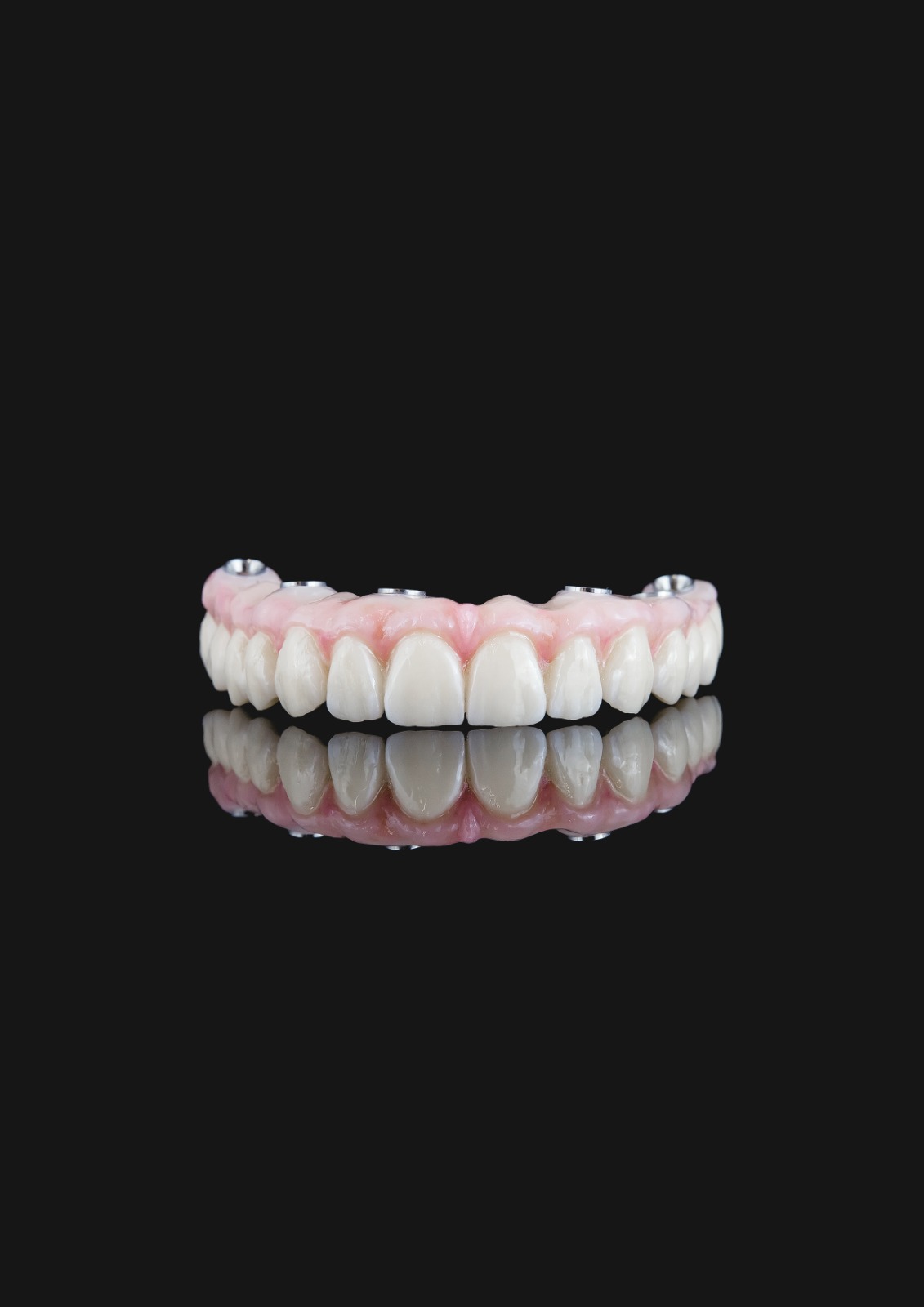
from conventional implant to fitting
from CT scan to crown
for most patients to return to office work
of implants for the doctor to choose from
What is an implant and how does it replace a missing tooth?
An implant is an artificial titanium root that the surgeon fixes inside the jawbone in the place of the missing tooth’s root, and the bone bonds to its surface within months until it is as stable as a natural root. The doctor then fits an abutment and a crown in your tooth color, so no difference shows when you speak or smile. An implant consists of 3 parts:
| Part | What it is | Its role |
|---|---|---|
| Implant fixture | A small titanium screw | Replaces the tooth root inside the bone |
| Abutment | A connecting piece above the implant | Joins the implant to the visible crown |
| Crown | A tooth of zirconia or porcelain | The visible part you chew with |
Dental implants at La Clinica
Why choose an implant instead of a bridge or denture?
An implant replaces the tooth root itself, unlike a bridge and a denture, so the doctor does not need to file the neighboring teeth as with a bridge, and it does not move while eating as may happen with a denture. It also helps limit bone shrinkage after extraction, but its initial cost is higher, and it needs surgery and several months. The table compares it with the two alternatives:
| Criterion | Implant | Bridge | Removable denture |
|---|---|---|---|
| Neighboring teeth | Not touched | Filed to carry the bridge | Sometimes used to hold a partial denture |
| Stability while eating | Fixed | Fixed | May move |
| Bone after extraction | Helps limit its shrinkage | Does not prevent shrinkage under the artificial tooth | Does not prevent shrinkage |
| Time until the final tooth | Usually 3 to 6 months | About two weeks | Several measuring and try-in visits |
| Approximate lifespan | More than 90% of implants are intact after 10 years | 5 to 15 years | 7 to 10 years |
| Initial cost | Highest | Lower | Lowest |
If the neighboring teeth are healthy and the bone is sufficient, an implant is usually more suitable, but if they need dental restorations anyway, a bridge may be a faster and cheaper option.
What types of dental implants are there at La Clinica?
La Clinica offers 4 methods of implants, and the doctor chooses among them according to the amount of bone, the number of missing teeth, and whether the tooth is still in the mouth or was extracted some time ago. Some cases need a bone graft or sinus lift before any method, and the doctor decides this from the CT scan.
Conventional implant in two stages
Conventional implants begin with fixing the implant inside the bone, then leaving it 3 to 6 months to bond with it, after which the final crown is fitted. It suits most cases, especially when the tooth was extracted some time ago and its place has healed, and it is the method against which implant results are measured in most studies.
Immediate implant
In an immediate implant the implant is fixed in the same session as the tooth extraction, and a temporary tooth is usually fitted on it the same day if it is stable enough, then replaced by the final crown after the bone bonds. It saves time and preserves the shape of the gum, but it does not suit cases of severe inflammation around the tooth or weak bone.
Minimally invasive implant
In a minimally invasive implant the implant is fixed without fully opening the gum, with the help of a surgical guide designed from the CT scan, and laser is used in some cases to treat the tissue around the implant. It reduces pain and swelling after surgery, but it suits selected cases only where the bone is sufficient and clear on the scan.
Full-arch implants on 4 to 6 implants
In full-arch implants, 4 to 6 implants are fixed in the jaw to carry a complete fixed bridge instead of a removable denture, known as All-on-4 and All-on-6. It suits those who have lost all or most of the teeth of a jaw, and the doctor decides the number and position of the implants according to the amount of bone in the jaw, and may fit a temporary bridge on the day of surgery.
Bone grafting and sinus lift
Bone grafting adds bone to the jaw when it is thinner or shorter than needed to hold the implant, and a sinus lift raises the sinus membrane above the upper molars so bone can be added beneath it. The grafted area usually needs 3 to 6 months to heal before the implant, and sometimes grafting and the implant are done in one session.
When is an implant postponed or not suitable for you?
An implant is postponed when there is something in the mouth or body that prevents the implant from bonding with the bone, and the doctor treats the cause first in most cases and then begins. There is no upper age limit, as general health and the amount of bone decide more than age. These are the main cases that postpone an implant:
Severe gum inflammation
Treated before the implant so the inflammation does not spread to the bone around it.
Weak or insufficient bone
May need a graft or sinus lift before the implant.
Jaw growth not complete
The implant is postponed until jaw growth stops, usually in the late teens for girls and early twenties for boys, and the doctor confirms this by X-ray.
Uncontrolled diabetes
It slows healing and raises the risk of implant failure, so the doctor asks for blood sugar to be controlled first.
Smoking
It raises the risk of implant failure to about two or three times, and the doctor asks you to stop before and after surgery.
Teeth grinding
It presses on the implant strongly, and usually needs a night guard after fitting.
What are the steps of dental implants at La Clinica?
Dental implants go through 6 steps from the CT scan to fitting the crown, and take 3 to 6 months if you do not need a graft, and roughly 9 to 15 months if you need a separate graft before the implant. The longest stage is waiting for the implant to bond with the bone, a stage in which you do not need many visits.
Attend the initial examination so the doctor takes a 3D CT scan (CBCT) of the jaw, and measures the amount of bone and the position of the nerves and sinus.
Have the bone graft or sinus lift if you need it, and wait 3 to 6 months for it to heal.
Attend the implant placement session under local anesthesia, which usually takes less than an hour for a single tooth.
Wait 3 to 6 months for the implant to bond with the bone, with a temporary tooth in suitable cases.
Let the doctor take the impression of the mouth and fit the abutment, so the lab makes the crown within 2 to 4 weeks.
Receive the final crown after the bite is adjusted, then attend the regular implant follow-up.
What do you do after dental implants?
The first three days after surgery are the most uncomfortable, as swelling usually peaks on the second or third day then eases gradually. Most patients return to their office work after 2 to 3 days, while physical work needs more rest. Follow these instructions in the first two weeks:
- Apply cold compresses to the cheek from the outside in the first 24 hours to reduce swelling.
- Eat soft, cold or lukewarm food in the first days, such as yogurt, soup and mashed potatoes, and chew away from the implant site.
- Do not use a straw or rinse hard in the first week, so the blood clot at the surgical site is not disturbed.
- Avoid smoking for at least two weeks after surgery.
- Brush your teeth gently with a soft brush starting the next day, avoiding the surgical site directly.
- Call the clinic if pain increases after the third day instead of easing, if swelling returns after it had settled, or if pus appears.
How do you look after the implant in the long term?
You look after the implant with the same habits as caring for your natural teeth, with more attention to the gum around it, because inflammation of the tissues around the implant affects about 5% to 10% of implants over time and leads to bone loss around it if neglected. Discovering it early at the regular check-up makes it easier to treat.
Brush your teeth twice a day with a soft brush and fluoride toothpaste, and use an interdental brush or floss around the implant every day. Avoid biting ice and hard things, and ask about a night guard if you grind your teeth. Visit the clinic for regular check-ups and cleaning, so the doctor can make sure the bone around the implant is healthy.
How long do implanted teeth last?
More than 90% of dental implants stay intact after 10 years, as a scientific review published in 2019 estimated the survival rate of implants after 10 years at about 93%, with a slightly lower rate for those over 65. The crown above the implant is treated like any crown, and may need renewing after some years.
| Part | Expected duration | What shortens its life |
|---|---|---|
| The implant | Most last more than 10 years, and many longer | Smoking, inflammation of the gum around the implant, and uncontrolled diabetes |
| Crown | 5 to 15 years | Grinding, biting hard things, and breaking the porcelain |
How much does an implant cost at La Clinica?
The doctor determines the price of implants after the CT scan, because the cost changes with the number of implants, your need for a bone graft or sinus lift, and the type of crown above the implant. At the consultation you learn the full cost of the plan before starting, with the installment options available at the clinic, so you can plan for it before the first session.
The price rises or falls according to these factors:
- The number of implants, from a single tooth to a full jaw on 4 to 6 implants.
- Bone grafting or sinus lift, because they are additional surgery.
- The type of implant and its manufacturer.
- The type of crown above it, zirconia or porcelain.
- Tooth extraction or gum treatment before the implant.
Ask at the consultation about the total price including the abutment, crown and temporary tooth, because some offers state the price of the implant alone.
Dental implants in Riyadh and Khobar: who are the consultants?
Implants at La Clinica are carried out by 4 consultants in implants, gum surgery and prosthetics, working at the Riyadh and Khobar branches. Having a gum surgeon and a prosthodontist in the same team means the surgery and the crown are planned together from the start. For dental implants in Khobar you can book with Dr. Yousef Al-Othman, Dr. Arwa Al-Haqeel or Dr. Anas Abu Anq.

Prosthetics and dental implant consultant: Cardiff University and Fellowship of the Royal College of Surgeons of Edinburgh

Prosthetics and dental implant consultant: Saudi Board in Prosthodontics

Cosmetic gum surgery and dental implant consultant
Frequently asked questions about implants
Are implants painful?
Pain is not expected during surgery, because it is done under local anesthesia, and most patients describe the feeling as pressure, not pain. After the anesthesia wears off you may feel pain like that of a tooth extraction, peaking in the first 3 days then easing, and it is usually controlled by a painkiller the doctor prescribes.
Can more than one tooth be implanted in a single session?
Yes, more than one implant can be fixed in a single session, and this is what happens in full-arch implants on 4 to 6 implants. The doctor decides the number of implants per session according to the amount of bone and your general health, and may split them across two sessions if the case needs grafting in more than one place.
Are implants suitable for people with diabetes?
Yes, implants are suitable for people with diabetes in most cases if blood sugar is controlled, because uncontrolled diabetes slows healing and raises the risk of implant failure. That is why the doctor usually asks for an HbA1c test before surgery, and may coordinate with your treating doctor if needed before setting a surgery date.
Can an implant fail?
Yes, a small proportion of implants may fail, either because the bone did not bond with the implant in the first months, or because of inflammation of the tissues around it after years. The main things that raise the risk are smoking, uncontrolled diabetes, teeth grinding and neglected cleaning, and the implant can often be redone after the site heals.
When do I return to work after an implant?
Most patients return to office work 2 to 3 days after surgery, when the swelling starts to go down. Those who do physical work or lift weights usually need a week, because heavy exertion may increase swelling and bleeding in the first days after surgery.
Where to start?
If you have lost a tooth recently, do not delay the examination for long, because bone starts to shrink after extraction, and the longer you wait the more likely you are to need a graft. Start with a CT scan that determines the amount of bone and the suitable type of implant for you, then decide knowing the duration and cost.
Call or WhatsApp: Riyadh branch +966 53 657 0591 · Khobar branch +966 50 707 0593